
Two researchers, one UNLOKall webinar, and the data now reshaping how clinicians counsel new parents.
For years, parents were told to delay peanuts, eggs, and other allergenic foods well past a baby's first birthday. That advice has since reversed, and new data presented together in an UNLOKall webinar on early life nutrition suggest the real story is more specific than simply "introduce early": colostrum in the first three days of life, maternal diet during breastfeeding, and the timing of clinical counselling all appear to shape a child's later allergy risk, and each is something a clinician can act on.
A/Prof. Debbie Palmer, a dietitian and Food Allergy Stream co-chair at Australia's National Allergy Centre of Excellence, shared a before-and-after comparison of high-risk infants: one cohort born under the old delayed-introduction advice, one born after families received hands-on guidance on introducing egg and peanut at 6 months. Both cohorts were drawn from the same high-risk population, which strengthens the comparison. It's one of the clearest links yet between a specific counselling practice and a measurable drop in allergy rates.
Egg allergy
Peanut allergy
High-risk infants, before vs. after families received hands-on egg and peanut introduction advice at 6 months. Source: A/Prof. Debbie Palmer, National Allergy Centre of Excellence.
A/Prof. Palmer noted that timing mattered as much as content: families acted most readily right as solids began, not earlier in pregnancy or infancy. Because the shift reflects real-world practice rather than a controlled trial, she considers it a particularly strong signal for clinicians, and a reminder that written guidelines alone rarely change behaviour without a structured moment to deliver them.
The First 72 Hours: A Role for Colostrum
A newly published Perth cohort study classified infants by whether they received supplemental formula, and therefore less colostrum, in their first three days of life. A/Prof. Palmer described the pattern as graded: the more colostrum feeds an infant received in that window, the lower their allergy risk later on. She called it an early but promising signal, not yet a guideline change, one her team plans to test further alongside upcoming trials on maternal allergen intake.
Among infants given supplemental formula, and therefore less colostrum, in their first 3 days, compared with infants who were exclusively colostrum-fed. Source: A/Prof. Debbie Palmer, Perth birth cohort data.
The Triple Exposure Hypothesis
Prof. Meghan Azad, Canada Research Chair in Early Nutrition at the University of Manitoba, brought a complementary angle from the CHILD Cohort Study, which has followed thousands of Canadian families since 2010. Her team confirmed that early peanut introduction lowers sensitization risk, but found the protection was strongest under one specific condition: the mother regularly ate peanuts herself throughout pregnancy and lactation. By age five, that combination was linked to the lowest rates of peanut sensitization seen anywhere in the cohort.
Maternal diet
Regular peanut intake during pregnancy
Breastfeeding
Continued exposure through breast milk
Early introduction
Direct exposure to peanut at weaning
Source: Prof. Meghan Azad, CHILD Cohort Study. Prof. Azad noted this is observational evidence; a newly funded NIH study will test it directly.
Where the Research Is Headed
Both speakers pointed to trials already underway. A/Prof. Palmer's team is testing maternal egg, peanut, and cashew intake during pregnancy and lactation, while Prof. Azad's group is identifying which specific human milk components, including human milk oligosaccharides, drive the protective effect seen in the CHILD Cohort. Both are expected to report results within the next two to three years.
Neither dataset is mature enough yet for formal guidance, but both speakers suggested maternal diet during breastfeeding may become a real, evidence-based lever for allergy prevention. For clinicians, the message for now is less about a new protocol and more about confidence: continuing to counsel early introduction and colostrum feeding is already well supported by the evidence in hand. That guidance may sharpen as the newer trials mature, but it isn't contingent on waiting for them.
Key Takeaways
-
Timing changes outcomes.
Hands-on counselling at 6 months accompanied a drop from 11.7% to 2.8% in egg allergy, and 5.8% to 1.1% in peanut allergy. — A/Prof. Debbie Palmer
-
Colostrum in the first 72 hours may matter.
Less colostrum in the first 3 days tracked with a 5-fold rise in peanut allergy and an 11-fold rise in multiple food allergies. — A/Prof. Debbie Palmer
-
Peanut protection compounds.
Maternal diet, breastfeeding, and early introduction together produced the strongest protection, more than any one factor alone. — Prof. Meghan Azad
-
Counsel at the right moment.
Families were most receptive to allergen-introduction guidance right as solids were introduced, not earlier. — A/Prof. Debbie Palmer
-
More evidence is coming.
Large trials already underway are expected to refine dosing, timing, and maternal-diet recommendations in the years ahead. — A/Prof. Palmer and Prof. Azad
Watch the Full Session and Earn 1 CME Credit
This blog only scratches the surface of what A/Prof. Palmer and Prof. Azad presented. The full recording includes their complete trial methodology, additional CHILD Cohort Study data on the infant microbiome and asthma risk, and a live Q&A covering hydrolyzed formula, gluten and coeliac disease, and the marketing claims behind probiotic-fortified formulas, plus 1 CME credit for healthcare professionals who complete the session. Register free on UNLOKall to watch the full webinar and claim your CME credit.
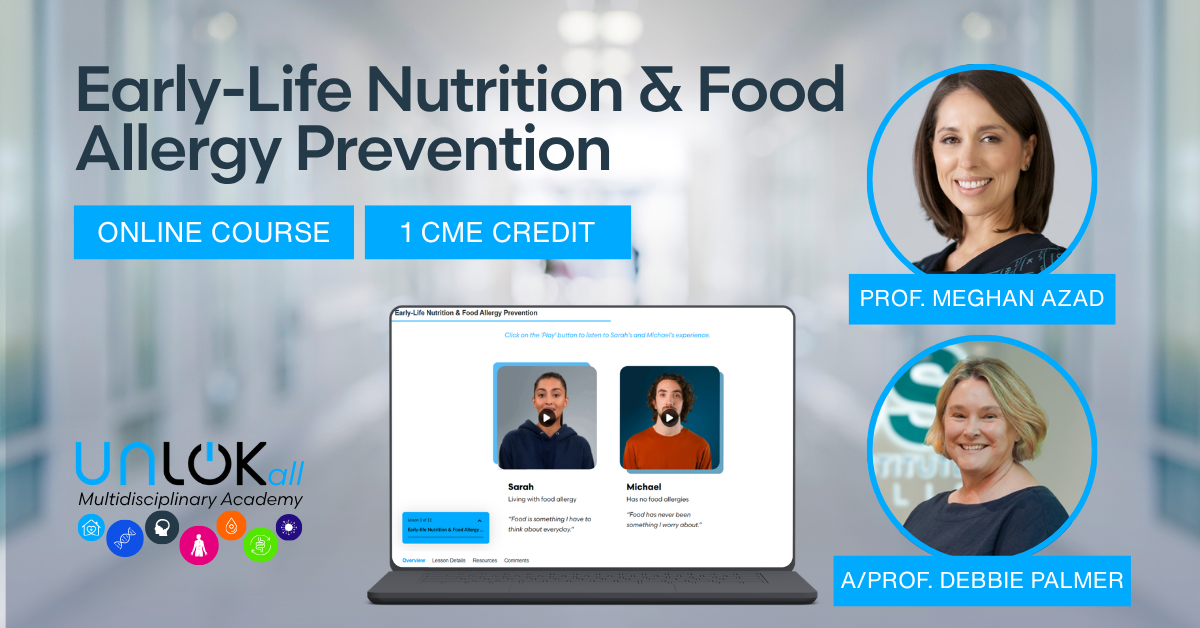
Early-Life Nutrition & Food Allergy Prevention
Watch the SessionMeet the Experts

Prof. Meghan Azad
Canada Research Chair in Early Nutrition at the University of Manitoba.
Learn more
A/Prof. Debbie Palmer
Dietitian and Food Allergy Stream co-chair at Australia's National Allergy Centre of Excellence.